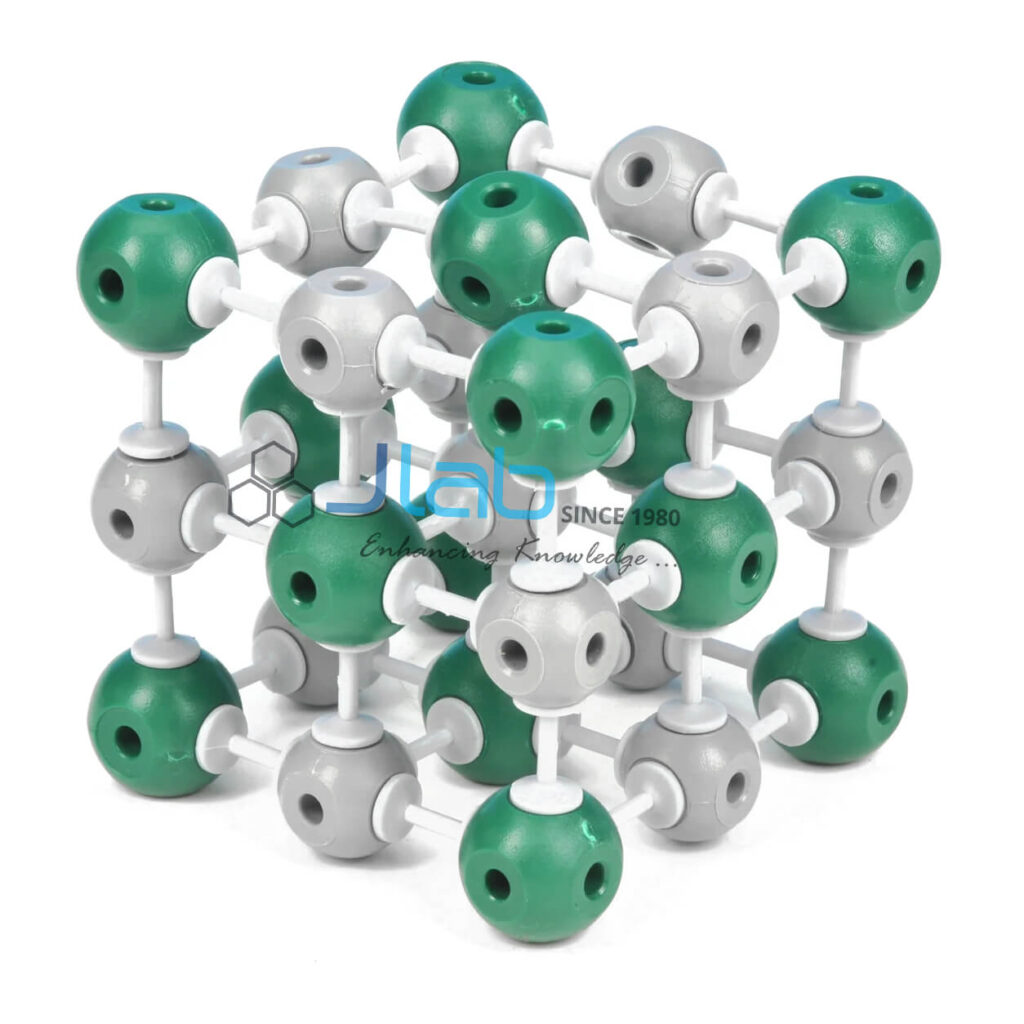
The salt crystal lattice model (sodium chloride, NaCl) is a physical or conceptual representation used primarily to teach, demonstrate, and analyze the three-dimensional arrangement of ions in solid-state chemistry and materials science
Visualizing Ionic Bonding and Packing: It demonstrates how positively charged sodium ions and negatively charged chloride ions alternate in a repeating 1:1 ratio within a face-centered cubic (FCC) structure.
Understanding Unit Cells and Coordination Numbers: Students and researchers use it to calculate unit cell contents and show that each ion is surrounded by six oppositely charged neighbor.
Explaining Physical Properties: The model helps link microscopic crystal geometry to macroscopic traits such as high melting points, brittleness, cleavage planes, and lattice energy.
Physics and Geological Studies: It is used in X-ray diffraction (XRD) education, studying crystal defects, and identifying natural halite mineral (rock salt) structures.
Optical and Infrared Applications: In specialized laboratory and industrial contexts, large single-crystal salt lattices are utilized as optical transmission windows and prisms for infrared and ultraviolet spectroscopy.
No price shown online — add this to your list and we'll quote you based on the quantity you need.